Friday, October 14, 2016

Comments Count!


We are enjoying being a part of Edublog's Student Blogging Challenge! Week 2 Task: Time To Comment


The comment section is where a blog can really come to life! It is a place where you can interact with readers and learn more about one another. So, we spent the week becoming better commenters!


How I teach my third graders to comment.


First, we learn how to comment using an informational video made by my former students. Through this video, we learn the FIVE tips for leaving a quality comment:


Step 1: Compliment the blogger in a specific way.
Step 2: Add new factual information.
Step 3: Make a connection.
Step 4: Ask a relevant question to get a conversation going.
Step 5: Always proofread your comment before publishing! 


★     ★     ★     ★     ★


A few other ways to teach commenting.


Collaborative Commenting


Here is a fantastic group comment from our blogging buddies in Hershey, Pennsylvania. Their librarian, Mrs. Talley, connects her classes to ours via the comment section on our 366 Photo-of-the-Day Blog


Example: 


The photo that inspired a collaborative comment. 


Mrs. Talley composed a quality comment with a class during their weekly visit to the library. 


(Click to enlarge)
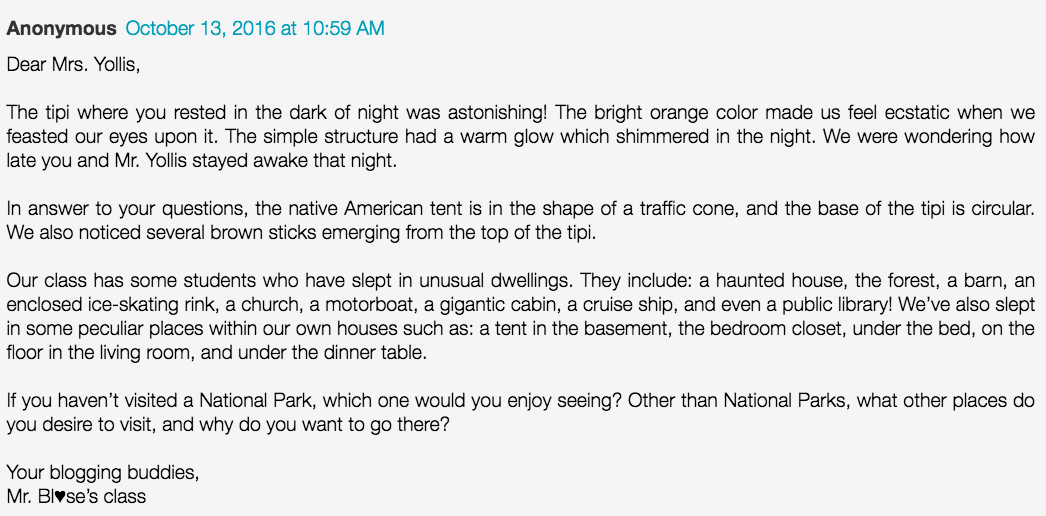


As a group, I helped compose a reply. (Since I am the only one who can type proficiently, I type for my student bloggers. Soon they'll be typists and will be able to compose quality comments themselves.) Any student who added an idea or sentence gets his/her name added to the closing of the comment. 


(click to enlarge)


Learning From One Another ★ 


A weekly homework assignment is to leave a blog comment by Friday on a blog post of interest. Students must have parent supervision on the blog. 

This photo from our  BreakOut EDU experience brought an interesting  comment from a student. 

Photo by Mrs. Yollis


Check out Elie's analogy:  BreakOut EDU reminds me of a restaurant.  


(Click to enlarge)


Elie shared his comment in class, and we talked about analogies. Before long, another student left a comment with a different analogy. Hayden thinks that BreakOut EDU is like kayaking in a double kayak!  


Again, collaborative comments are a great way to teach this important blogging skill. This group comment was written by Reese, Elie, Lola, Rose, and Nolan.


 Learning From Parents ★ 


Parents, called Virtual Volunteers, help us learn about commenting! Here is a wonderful comment about our BreakOut EDU experience from Nolan's mom. 


(click to enlarge)


What are some other ways to teach 
commenting skills?


Monday, October 10, 2016

Student Blogging Challenge!


We are excited to be a part of Edublog's Student Blogging Challenge! 


This is week number one out of the ten week project
(We are sorry, we are a little late publishing.) 


There are two tasks for week number 1. First, make an avatar to represent your class. An avatar is an image used to represent yourself online. Mrs. Yollis' avatar is a photo of her standing next to a Google Map marker at the Googleplex in Mountain View, California. What does this avatar tell you about Mrs. Yollis?


Here is our class avatar. Mrs. Yollis took a photo and then she modified it using the Prisma app. 


How do you like the avatar?

What does it say about us? 


 Second, make an About Me page or post telling a little bit about your state or country. Let's get started! 


Here is a wonderful video about our state, California. 

 Enjoy!


Here is another resource with photos about California!


Tell us about yourself. 

Where are you from? 
What are the regions like there? 

What is great about your state or country? 

Are there any problems happening in your country like our drought?   

Friday, October 7, 2016

BreakOut EDU!


Mrs. Garcia came to our room today with a fabulous game! 
It was called BreakOut EDU


Photo by Mrs. Yollis

First, Mrs. Yollis put us into eight teams, one for each letter in the word TEAMWORK. Then Mrs. Garcia explained the rules. We would have 45 minutes to solve eight problems. A correct answer would lead to a number or word that unlocked a lock. Two hints were permitted


Photo by Mrs. Yollis


Would we be able to unlock them all?  


Photo by Mrs. Yollis 


TEAMWORK was important!
If you finished your task and unlocked one lock, you were free to go and help other teams. 


 Everyone was intrigued with the locks.  


Photo by Mrs. Yollis 


With 45 minutes on the clock, we began our challenge! 


Some students worked with Morse code.


Others constructed a time line. 


These two are discussing a math task to solve a mystery. 


Hundreds charts and logical reasoning were used repeatedly.


Sometimes the locks opened. Other times they did not. 
If the code didn't open the lock, we had to try something new. 


One by one we began our escape! 

Here we are at the halfway mark! Four unlocked. 


With over nine minutes to spare, we unlocked the box! This was our second attempt to break out, and we used teamwork and perseverance to succeed


Photo by Mrs. Garcia

We loved this type of collaborative learning!  A tip of the hat to Jeanine Huebner for the BreakOut EDU tasks! 


Without revealing too many clues, what was difficult about your task?

What did you learn about yourself from this experience? 


Monday, October 3, 2016

Quality Commenting :: Five Tips


WHY have a classroom blog?


Here is a video I made with my second and third graders about the value of blogging. I hope it convinces you to start a class blog!


Blogging has many parts: the post, the comments, and the sidebar.

If you do a good job with all of the parts, your blog will be more interesting.

Today we will focus on quality comments!


Content is key!


In our class, we evaluate our blog comments. A one-point comment is a general comment that doesn't add very much to the post.   Example: I like your blog. Please visit mine! 

A two-point comment adds something to the comment conversation. A commenter might compliment the writer in a specific way or add new information. Another idea is to make a connection. Maybe the post reminds you of an experience that you've had. Share that connection!  Try to end your comment with a relevant question. That way, an interesting conversation can develop.


What should I say in my comment?


Here is a video made by Mrs. Yollis' students called How to Compose a Quality Comment!  It offers FIVE tips to help you take your comments to the next level!


We like to open our comments with a greeting and end with a closing. We choose to do this as it makes it easier for us to follow the conversation within a comment section.


-For Advanced Bloggers-

Some bloggers like to use HTML code to make their comments better.  Learning to write HTML code, or HTML tags, is a somewhat simple way to take your comment to the next level.


HTML (Hypertext Markup Language) is a language.


*     *     *     *     *


To write HTML code, use the following symbols:


Important: Do not add a space between the HTML tag and the word or sentence.


1.  To put text in italics, place this HTML code around the text:


The sentence will look like this when published:
 

Bloggers should always proofread a comment before publishing.


2.  To make text bold, place this HTML code around the text:


The sentence will look like this when published: 


Bloggers should always proofread a comment before publishing.


3.  To make a hyperlink, it gets a little tricky.

Use the following HTML code around the URL and add your own link word/words:


  [The URL is the address of the web page. It starts with http://www…]

The HTML code below:


Will become this hyperlink when published:


                                                                 Mrs. Yollis’ Website


Sometimes it is hard to remember the HTML codes. I keep an HTML word document on my desktop with all the common codes, especially the one to create a hyperlink. Here is a video demonstrating how easy it is to a create a hyperlink if you have the code set up in a Word doc.


If you like to add fun shapes...here are those codes!


What did you learn about quality commenting? 
 Why is it important to proofread a comment before pressing publish? 

Have you ever had a conversation in a comment section?


Wednesday, September 21, 2016

So Long Summer :: Hello Fall!


FACT: Seasons change as we orbit the sun.

SpringSummerAutumnWinter

Twice a year, around March 20 or 21 and Sept. 22 or 23, our sun shines directly over the equator. That event marks the beginning of spring or fall. What is the equator?


Public Domain photo


e·qua·tor
[əˈkwā•dər]
noun
  1. an imaginary line drawn around the earth equally distant from both poles, dividing the earth into northern and southern hemispheres and constituting the parallel of latitude 0°.


In March when the sun shines directly over the equator, the event is called the spring or vernal equinox. In September when the sun shines directly over the equator, the event is called the fall or autumnal equinox


The Autumnal Equinox will occur in Los Angeles, California, U.S.A. on Thursday, September 22, 2016. at 7:21 A.M.


Things to look for in fall:

1. Deciduous (di•si•jo͞o•əs) trees will change color and drop all their leaves. Evergreen trees will not. Evergreen trees will stay forever green. :-) Why do the leaves of deciduous trees change color? Use World Book Online to research. Remember, do NOT copy sentences. That is plagiarism, and it is against the law! Take notes, and then turn your notes into your own sentences. 


Photo by Grandma Barb


2. On the equinox, there are exactly 12 hours of daylight and 12 hours of night. The day and night hours are equal. However, as we continue into fall, the days will get shorter and the night hours will get longer. This pattern will continue until we reach the winter solstice. That is the longest night of the year and marks a new season, winter.


3.  Because the northern hemisphere is now tilted away from the sun, the days will start to become cooler. People will change their behavior. What sorts of behavioral changes will your family make as the days get shorter and cooler?  (In southern California, we have mild climate. We don't get too cold in our community.)

There are many fall festivals or holidays. Watch the BrainPop video about fall to learn about the many harvest festivals celebrated. Do you celebrate any of these autumn holidays? If so, please share so we can learn from you! 

Check out the FREE BrainPop video about Fall. 


4. Some animals in the northern hemisphere will change their behavior. As fall leads to winter, some animals migrate, or move, to a warmer area. Others try to fatten up for the winter they know is coming. 


Again, BrainPop Jr. has a FREE video about fall. 


Share some fun facts about fall!
Did you use BrainPop or World Book Online as a reference? 


If you are in the southern hemisphere, tell us what season you are enjoying! How are you changing your behavior? 


Monday, September 12, 2016

Super Subjects and Plentiful Predicates!

Mrs. Yollis' class has been working on learning about 

what it takes to create a 
SENTENCE!


Photo by Mrs. Yollis 

We have learned that it takes two parts: 
SUBJECT 
and 
PREDICATE.


The subject tells the person or thing the sentence is about.


The predicate tells what the subject is or does.
The predicate always includes a verb!


Why don't you try creating a special sentence or two of your own?

Here are some possible subjects:


Buck...
Mrs. Yollis' students...
Panda and Beverly...
On her first day at school, Ramona...
Last Tuesday, our buddies...


Here are some possible predicates:


...took a tour of our classroom. 
...chased a duck across the pond.
...are positive people who persevere!
...worked together to learn how to create compatible numbers
...thought Mrs. Binney would give her a present.


After creating your sentence and typing it into your comment, tell us what the subject is and what the predicate is, or if you want to give us a challenge...Ask us to tell you what the subject and predicate are!

This grammar task is due by Friday! 

subject: This grammar task
predicate: is due by Friday! 

Wednesday, August 31, 2016

Back to School Night ~ 2016


Normally, Mrs. Yollis' class looks like this.


Photo by Mrs. Yollis


Photo by Mrs. Yollis 


Tonight, the classroom looked like this!


Photo by Mrs. Yollis


Photo by Mrs. Yollis 


It was Back to School Night!
Parents came to hear about third grade!
Lots of information was shared about classroom expectations, curriculum, and resources. 


The centerpiece of the classroom is the blog. Mrs. Yollis shared a video she made about the value of blogging. Here is that video.


She also showed a wonderful video about supervising and guiding children on the web. It is a great video that really drives the point home. Thank you, Bill Genereux, for the fabulous movie. 


Parents left thoughtful notes for their child. With Dry Erase pens, you can write right on the desk! Everyone loved it!


*      *      *      *      *


What are you excited to learn about this year?


Parents, how is third grade different from when you were in school?